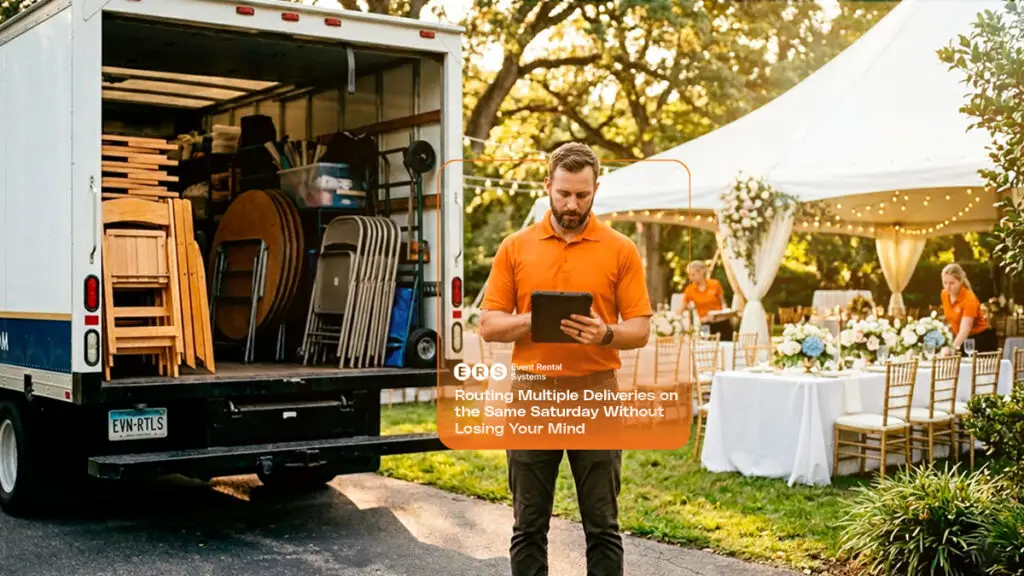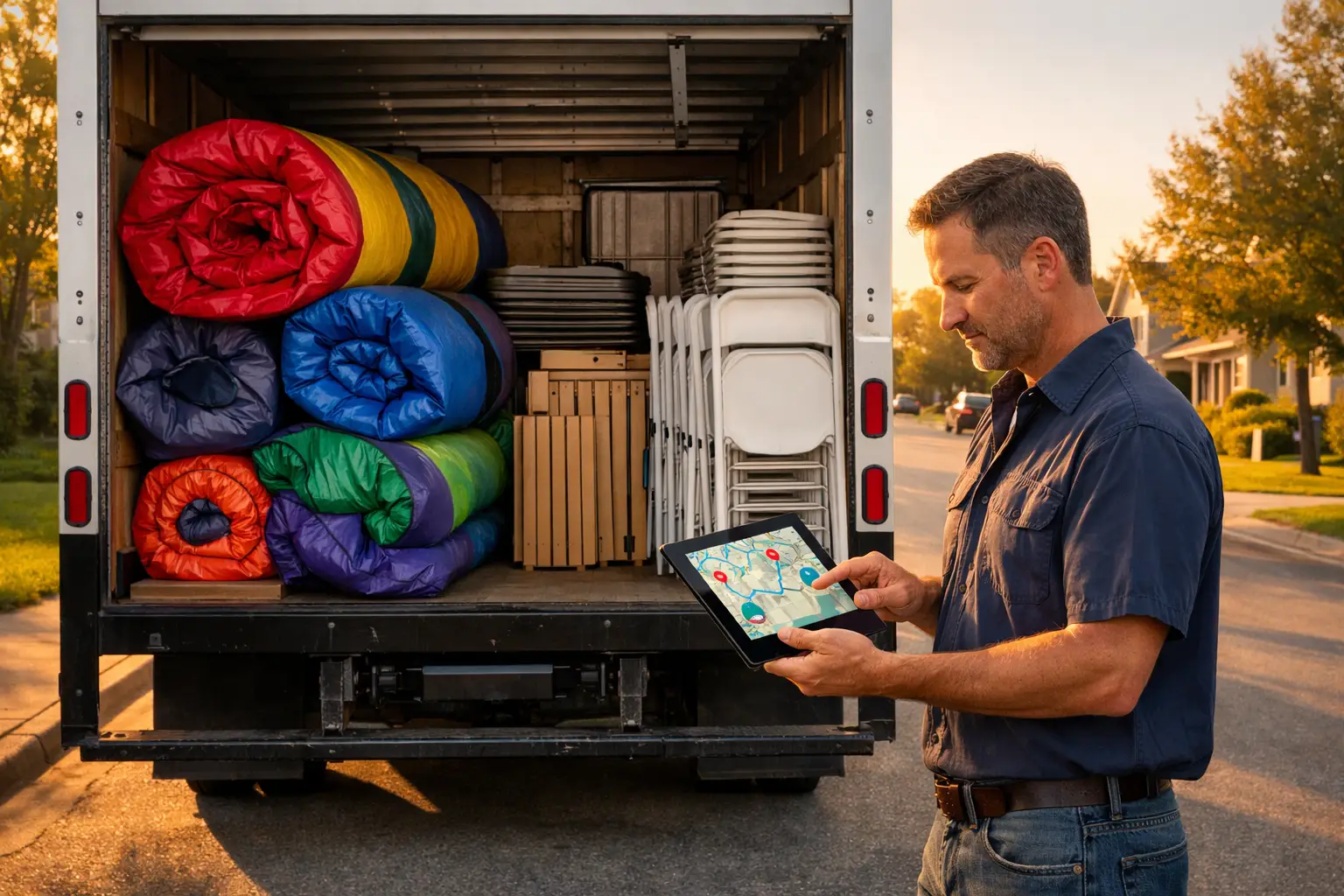

If you’re an event rental operator, deliveries are the backbone of your business. This is how your inventory gets utilized, and it sets the table for how your customers experience their event. It’s important to understand how to optimize delivery routes to save time, money, and offer exceptional service.
Unlike standard delivery businesses that focus on quick, one-way drop-offs, party and event rental deliveries involve transporting, staging, setting up, and recovering equipment across multiple events in a single day. And hard-to-predict factors like cancellations, traffic, and weather can completely change the itinerary. When delivery routes aren’t planned well, or can’t adapt to changes on event day, the domino effect goes far beyond drive time. It can affect the customer experience, your profit margins, and how much your business can grow.
Optimizing delivery routes isn’t just about reducing time on the road. When routes are planned with real-world constraints in mind, it lowers overhead costs, creates opportunities to run more deliveries in a day, and opens up your calendar to more bookings without adding trucks or staff.
Why Delivery Routing Matters for Party and Event Rental Businesses
Deliveries in an event rental business involve multiple bookings, organized loading and unloading, and hard setup windows. If you miss a scheduled delivery time, the entire event timeline, and all the deliveries that follow, can fall behind.
Unlike traditional delivery models, event rentals aren’t simple “drop-offs.” Trucks and crews are often supporting multiple events in a single day, which means route planning has to account for more than distance and drive time.
It requires planning around vehicle access, driver availability, traffic patterns, and tight setup windows — and being able to adjust quickly when something changes on event day.
New to the event rental industry? Don’t miss our complete guide covering everything you need to know to start an event rental business.
How to Optimize Delivery Routes – 3 Simple Strategies
Effective route planning for an event rental business means looking at the entire day as a system, not a series of individual stops. Distance and drive time matter, but there are other parts to the equation. The best planned routes are built around event schedules, crew capacity, and real-world constraints that can change quickly on event day.
Tools like Google Maps and other navigation apps are great for turn-by-turn directions, but they aren’t designed to handle the realities of event rental operations. They don’t account for hard setup windows, how inventory is assigned to events, load order, or the ripple effects that happen when one delivery runs late. In an event rental business, routing isn’t just about finding the fastest path, it’s about having an efficient plan for the entire day.
Plan Routes Around Event Time Windows, Not Just Distance
Having a full event calendar is certainly a great sign, but the long-term growth of your event rental business depends on how well you execute deliveries. That’s why figuring out how to optimize delivery routes is crucial for your business. Planning routes based solely on distance or drive time is one of the most common mistakes in event rentals. Because each event has a different setup window, the closest stop isn’t always the one you should head to first.
Events have expected start times, and that start time depends on your equipment being delivered and set up. There are several factors that can affect how long it takes to complete a delivery: distance, traffic, venue opening hours, and number of items being unloaded and setup to name a few. When routes aren’t well-planned with these variables in mind, even a small delay early in the day can push crews behind schedule for every delivery that follows.
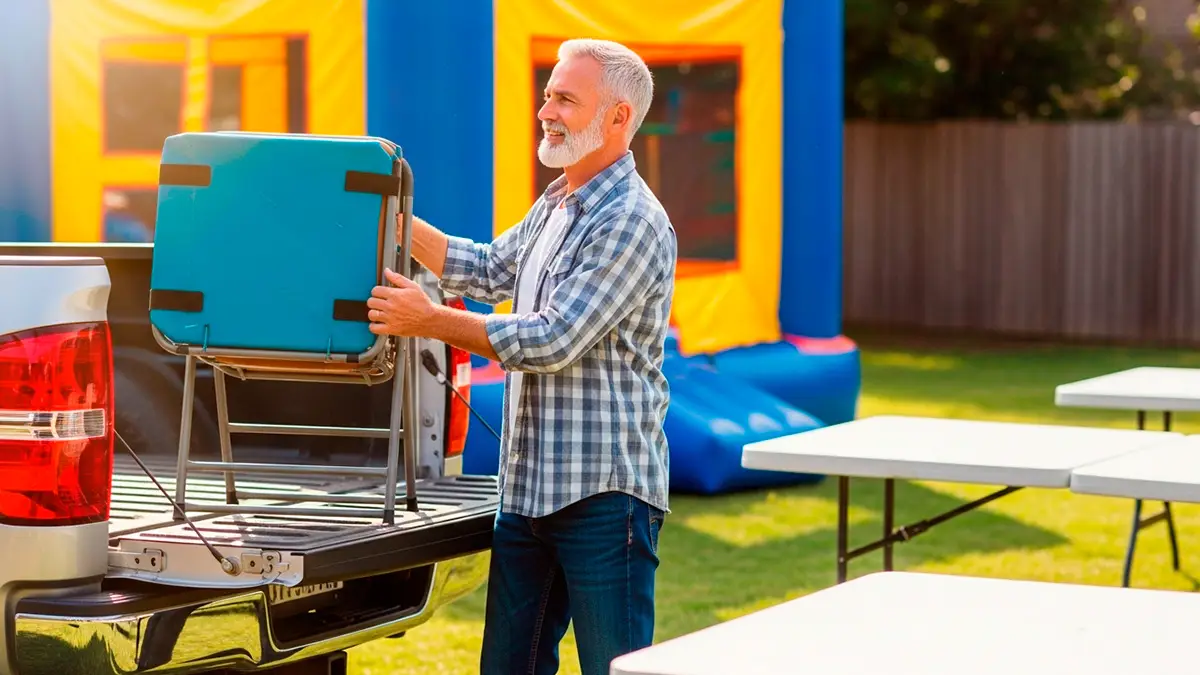
Effective route planning means accounting for the real time each stop will take — not just drive time. When you factor in traffic, venue access, and how much equipment needs to be unloaded and set, you can build realistic delivery windows that protect your schedule. That’s how you keep delivery days running smoothly, even with several consecutive deliveries scheduled in the same day.
Reduce On-site Delays with Smarter Loading
Even with solid route planning, deliveries can still take longer than they have to if the delivery truck isn’t loaded in a way that matches the stop order. On paper this sounds straightforward, but it’s one of the easiest things to lose control of as bookings increase and delivery days become more packed. In event rentals, time is often lost not on the road, but at the venue, when crews have to dig through a truck to find the right items, unload equipment they don’t need yet, or move things around just to reach what’s next.
Loading with the delivery sequence in mind keeps each stop fast and predictable. The equipment for the first stop should be the most accessible, and later stops should be staged so crews aren’t constantly re-handling inventory. This reduces mistakes and helps teams stay on schedule throughout the day.
It’s also important to understand how to store your event rentals for optimized loading and unloading. This makes the storage side more efficient. When the stop order is clear, pick lists and load lists can follow the same sequence. That way what gets loaded is accurate, and where it’s loaded makes sense for the crew that has to unload it later.
Build in Flexibility for Event-Day Changes
No matter how well a route is planned, event-day changes are inevitable. Weather shifts, last-minute cancellations, venue access issues, or customers requesting adjustments can all force crews to adapt on the fly.
When an event is canceled, it’s tempting to think you can simply skip that stop and continue as planned. But in event rentals, routes are built around several variables, and stop order is just one of them. Removing one delivery can result in an optimized route that is quite different from the original, and it could mean that the stops should now be reordered. Agile routing matters because it allows teams to optimize the plan for the rest of the day, not just move on to the next delivery.
How Better Delivery Route Planning Improves Your Business
Learning how to optimize delivery routes effects more than just event-day execution. It boosts your entire operation. With the right approach, it improves:
- Customer experience: more reliable delivery windows and fewer last-minute surprises
- Business efficiency: less wasted drive time, fewer re-runs, and lower overhead costs
- Capacity and growth: more stops per day, which opens your schedule to more bookings and revenue
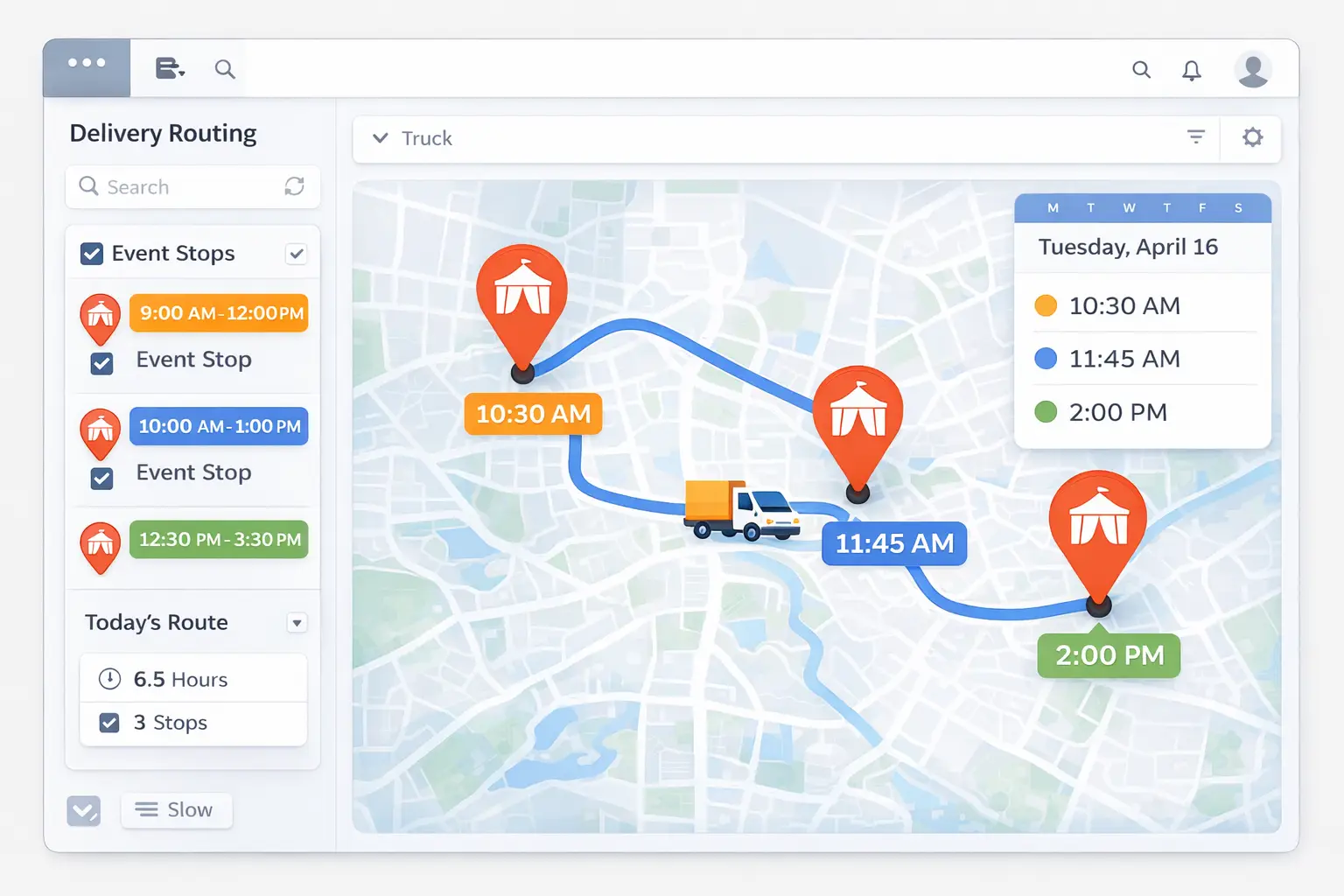
When delivery routes are planned with these outcomes in mind, your whole business runs better. And that’s where having the right tools really helps.
How Software Simplifies Event Rental Delivery Routing
Planning delivery routes manually gets harder as schedules fill up and delivery days get more complex. Eventually, manual methods of scheduling routes becomes too difficult, leaving you at risk of missing deliveries, delaying pickups, or wasting time on badly configured schedules. That’s why software is the best choice for rental companies. Event rental software brings routes, inventory, schedules, and crews together so deliveries are easier to run and more efficient to execute.
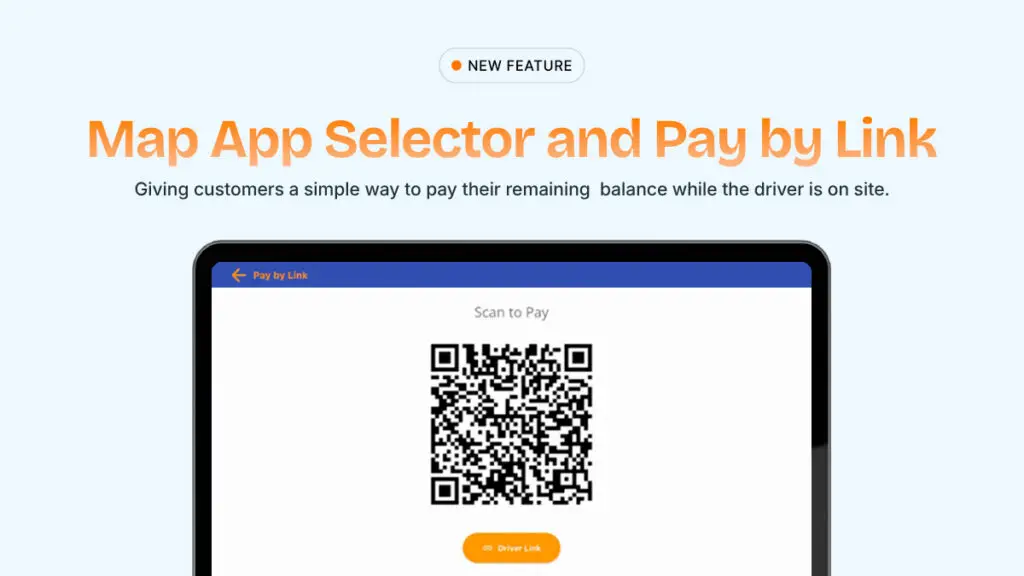
At ERS, we’ve created a software solution that simplifies routing, with an easy-to-use mobile app, online booking, inventory tracking, and more essential features. Instead of managing routes in isolation, ERS software allows you to:
- Give your team and drivers a clear plan for the day
- Build routes around event time windows, not just distance or drive time
- Adjust routes quickly when cancellations, weather, or access issues come up
- Know your delivery overhead so you can price accurately
The result is less guesswork and delivery days that stay on track, even when plans change. As an investment in efficiency, our event rental software helps you run tighter delivery days, cut unnecessary time and costs, and open up capacity for more bookings — without adding trucks or staff.
ERS event rental software can help your team run more efficient delivery days, schedule a free demo with us to learn more.