
Most businesses start in a home or small office, not a corporate building. Often with the owner using personal equipment and vehicles to make weekend deliveries and send emails. In the early stages, payroll is straightforward and HR barely exists.
But growth changes all of that. Once you start hiring staff, the admin side ramps up fast: payroll runs, tax filings, employee paperwork, compliance, and benefits decisions.
For crew-based rental businesses like tent and bounce house rentals, this complexity shows up quickly because staffing and schedules can change week to week.
A PEO (Professional Employer Organization) can help by handling key HR functions so the business owner can focus on operating the business and growing revenue.
In this guide, we’ll explain what a PEO is and break down five practical ways it helps small business owners spend less time on HR admin and more time running the business.
What Is a Professional Employment Organization (PEO)?
A Professional Employer Organization (PEO) is an external company that partners with small businesses to help manage key employer responsibilities like payroll, HR administration, compliance support, and employee benefits. The goal is simple: reduce the time and complexity of employing people so owners can stay focused on running the business.
It’s also worth clarifying what a PEO is not. A PEO isn’t a staffing agency, and it isn’t just payroll software. You still recruit and hire your team, set pay rates, manage schedules, and direct day-to-day work.
A PEO supports the administrative side of employment. This means it handles things like payroll processing, HR guidance, benefits administration, and compliance-related tasks, so you’re not piecing everything together on your own as the business grows.
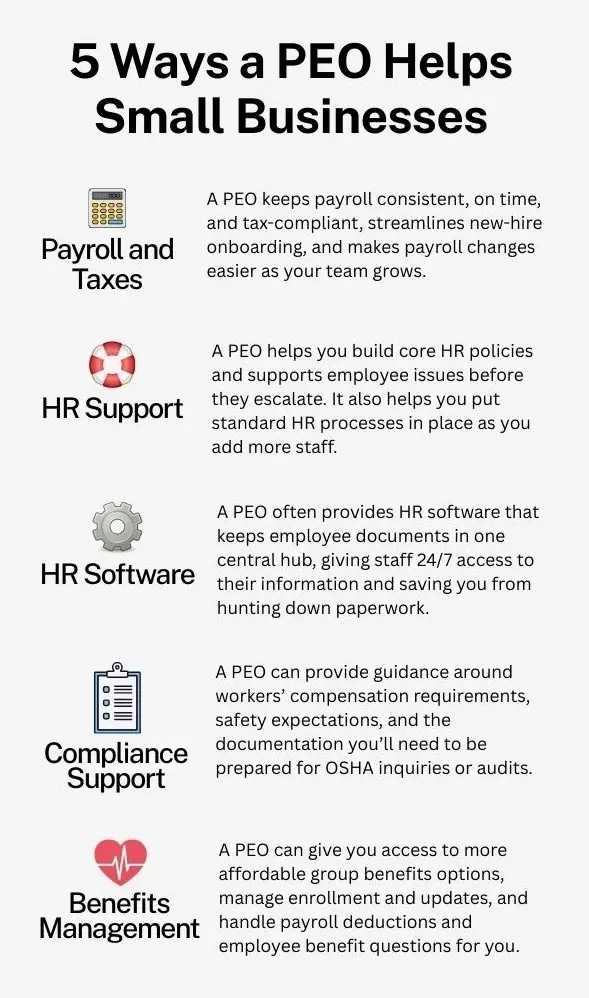
Below are five of the most common ways PEOs help small businesses reduce HR admin and stay focused on growth.
5 Ways a PEO Helps Small Businesses Scale & Focus
For many small business owners, the value of a PEO comes down to one question: does partnering with a PEO give you back the time and peace of mind to focus more on expanding the business?
While every company’s needs are different, most PEOs help in a few consistent areas that remove day-to-day friction and reduce administrative load. Below are five of the most common ways a PEO helps small businesses operate more efficiently as they grow.
Payroll and Tax Administration
Payroll can be overwhelming for a small business because it has to be done correctly and it has to be on time. It also involves more than just tracking hours and depositing funds. For event rental businesses, payroll can get even trickier during busy seasons, when staffing changes and hours fluctuate week to week. For this reason, many startup party rental businesses struggle with payroll errors and timely payments.
Some of the issues complicating payroll include:
- Federal, state, and local tax rules that can change how deductions are calculated
- Different employee classifications (W-2 vs. 1099, hourly vs. salaried, exempt vs. non-exempt)
- Mistakes can result in financial penalties (and sometimes back taxes)
- It gets more complicated as the business grows (more hires, pay changes)
A PEO helps small businesses manage these day-to-day payroll and tax administration tasks so owners aren’t taking time away from operations to make sure this is handled correctly.
Common outcomes of using a PEO include:
- More consistent payroll processing and pay schedules
- Support with payroll tax calculations, filings, and required forms
- Cleaner onboarding for new hires, including tax paperwork and direct deposit setup
- A smoother process for handling payroll changes as your team evolves
This is why many small businesses start by partnering with a PEO just for payroll before expanding into other services.
For many small businesses, the biggest benefit isn’t just saving time, it’s reducing errors and avoiding payroll-related headaches that can distract from making higher-value, business-specific decisions.
HR Support
HR isn’t something most owners need every day, but when it does come up, it can be a serious matter. A PEO can provide guidance and support for handling employee situations the right way, so you can make confident decisions when they arise.
A PEO can provide HR support in the form of:
- Help creating basic policies, templates, and documentation
- Guidance on onboarding, performance conversations, and terminations
- Support with employee questions and issues before they become bigger problems
- Recommendations for building repeatable processes as you add more staff
The value is having a clearer process and access to a reliable resource to use, so HR issues don’t interfere with running the business.
HR Software Tools
As your small business grows, one of the hidden problems isn’t just payroll. It’s managing employee information and processes across several emails, spreadsheets, and programs. Many small business owners end up piecing together a system themselves: one tool for payroll, another for time tracking, a shared folder for employee documents, and a series of manual edits to update everything.
Many PEOs eliminate this pain point by providing HR software tools that centralize these workflows in one place.
Specialized HR software packages from PEOs often include:
- A centralized hub for employee records, onboarding documents, and key forms
- Employee self-service access to pay stubs, tax forms, and personal info updates
- Tools or workflows for time tracking, PTO requests, and common HR admin tasks
The benefit isn’t the software by itself, it’s the time you get back when your HR processes are organized, automated, and not dependent on you personally.
Compliance Support and Risk Reduction
Hiring more employees will mean that compliance will become a larger responsibility. There are rules, documentation, and regulation that must be followed that could end up being costly if an error is made.
A PEO helps small businesses stay more organized and reduce avoidable mistakes by supporting compliance processes and providing guidance when questions come up.
Compliance areas that a PEO can help with include:
- Help keeping employee documentation, policies, and processes consistent as you hire
- Support related to workers’ compensation administration and reporting (requirements vary by provider and state)
- Guidance around workplace safety expectations and documentation, including preparation for issues like OSHA inquiries or audits
In businesses using heavy equipment, transport vehicles, and warehouse storage, compliance and risk reduction is key. Small business owners and operators may not properly set safety standards, especially in industries like party and event rentals where warehouse inventory storage, heavy equipment usage, and transportation play a large role in business operations.
Partnering with a PEO won’t make your business risk-free, but it can make compliance more manageable and reduce avoidable mistakes as your business grows.
An important aspect of compliance and risk reduction for party rentals is business insurance. Learn more about insurance for party and event rentals in our in-depth article.
Benefits Management
Many small businesses are finding it more and more difficult to offer employee benefits because of rising costs. Health insurance premiums, in particular, are rising faster than inflation and many expect these costs to keep trending upward. Watch a quick overview of small business benefits from PEO expert Michelle Lozano.
Partnering with a PEO can help with this challenge by giving small businesses access to benefits options as part of a much larger employee pool. Because PEOs represent many businesses, they often have more negotiating power than an individual small employer, which can lead to more competitive plan options and pricing than a business might be able to secure independently.
A PEO can help small businesses with benefits management by offering:
- Access to health insurance and other benefit options through the PEO’s group plans
- Support with benefits enrollment, life-event changes, and ongoing administration
- Help managing payroll deductions and employee questions related to benefits
- A more consistent and professional benefits experience for employees
The value goes beyond cost alone. Stronger benefits can make it easier to attract and retain reliable employees, while the administrative support helps keep benefits from becoming another time-consuming responsibility for the owner.
When Should a Small Business Partner With a PEO?
Most small business startups do not need a PEO. But for many, there will come a point where handling payroll, HR, and compliance in-house starts to slow things down more than it saves money. One of the best indicators of when a PEO partner is needed is employee count. Once your business has around 5 employees, partnering with a PEO makes sense. Once you reach 10 employees, managing payroll and HR internally can start to feel unsustainable.
But there are signs other than employee count that may suggest partnering with a PEO is a worthwhile decision. Some of these are:
- Payroll and HR tasks are taking up valuable time
- You’re not confident that payroll taxes, classifications, or compliance requirements are being handled correctly
- Hiring or onboarding new employees feels disorganized or inconsistent; especially when ramping up for seasonal demand
- You want to offer benefits, but cost or administration is holding you back
- You spend more time on admin work than growth-focused decisions
If you’re operating with a small, stable team, using a PEO may not be needed yet. But if you want to focus on growing, that means more employees, more HR work, and also more risk. Partnering with a PEO is a proven strategy to avoid these issues slowing your business down.
When a PEO Makes Sense for Party and Event Rental Businesses
Growing party and event rental businesses should consider partnering with a PEO due to industry specific challenges. Even if your rental business isn’t huge, factors like seasonal ramp-up and a mix of both part-time and full-time employees can make payroll, onboarding, and compliance complicated.
A PEO tends to make the most sense for rental businesses when:
- You’re hiring seasonal or part-time staff and onboarding is starting to feel messy
- You’re managing multiple drivers/crews and need more consistent documentation and processes
- You’ve had a close call (or a wake-up call) with payroll, workers’ comp, or compliance requirements
If you’re a rental business owner who is spending more time keeping up with HR admin than making business decisions that drive revenue, it’s probably a good time to look into partnering with a PEO.
Final Thoughts on Partnering With a PEO
As your rental business grows, payroll, compliance, and HR quickly become time-consuming responsibilities. Partnering with a PEO can streamline those tasks, reduce risk, and free you up to focus on running and growing your business. If the admin side of your rental business is becoming burdensome, taking time to research whether a PEO is a good fit for your team is time well spent.
What is the difference between a PEO and a staffing agency?
Unlike staffing agencies that supply temporary labor, a PEO partners with your existing workforce to manage HR, payroll, compliance, and benefits under a co-employment model while you retain day-to-day control.
Will a PEO replace my internal HR team?
A PEO doesn’t replace HR staff. A PEO augments your capabilities by providing systems, expertise, and administrative support so your team can focus on higher-level HR strategy.
Tell me how a PEO helps small businesses grow and scale?
By removing administrative burdens, ensuring compliance, and offering professional HR infrastructure, a PEO helps small businesses scale more efficiently and focus on revenue-driving activities.